
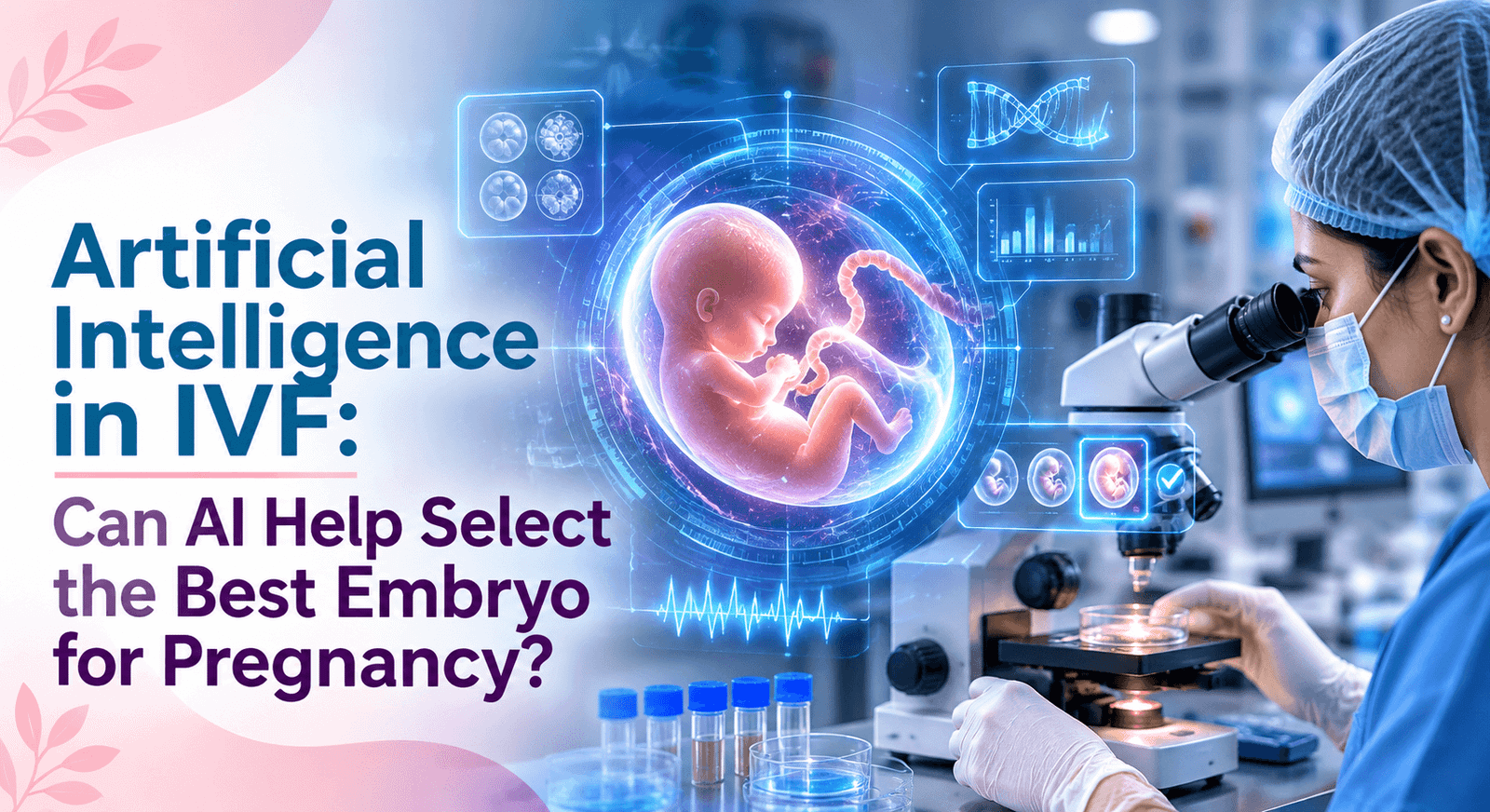
When couples begin IVF, one important question is which embryo should be transferred. Embryologists are specialists who check embryos by looking at their appearance and how they grow. Today, Artificial Intelligence in IVF is being studied as an additional tool that may make this assessment more consistent.
Artificial Intelligence in IVF can use software to analyse embryo images and time-lapse recordings for patterns. It may support decisions, but cannot guarantee pregnancy.
During IVF, eggs are fertilised in a laboratory. Embryologists monitor cell division, shape, and blastocyst development to decide which embryo may be suitable for transfer.
AI in embryo selection uses programmes trained on embryo images and development data. The software identifies patterns and may rank embryos by predicted potential, giving embryologists another source of information.
AI embryo grading means using computer software to study embryo images and give each embryo a score based on its appearance and development. Some systems use time-lapse images captured at different stages, while others analyse a still image.
It may help make embryo assessments more consistent. However, a higher score does not guarantee that an embryo will attach to the uterus or result in a baby. Embryologists must consider it alongside medical history and other clinical findings.
Artificial intelligence in fertility treatment may offer practical benefits when used carefully:
Benefits depend on software quality, training data, and clinical testing.
Some AI systems use special cameras inside IVF incubators. These cameras take pictures of embryos at regular intervals so specialists can monitor how they grow. Cameras capture images at regular intervals, allowing embryos to be monitored without removing them for every observation. AI software can assess the timing and pattern of cell divisions.
This embryo selection technology helps review development in greater detail. For a closer look at laboratory conditions, see Safal IVF’s guide to closed and open IVF labs.
AI-based IVF treatment is promising, but evidence is developing. I recommend keeping this point. It is important not to create unrealistic expectations among couples considering IVF.
Artificial Intelligence in IVF is a support tool, not a replacement for an experienced embryologist. IVF laboratory technology and AI in embryo selection work alongside clinical judgement and an individual treatment plan. A woman’s age, the quality of eggs and sperm, how the embryo develops, and the health of the uterus can also affect the chances of pregnancy. Modern IVF laboratory technology also includes imaging and monitoring tools, whose value depends on careful use.
AI technology may be helpful in some IVF treatments, but it is not necessary or suitable for every patient. Its usefulness depends on the technology available at the clinic, the experience of the medical team, and each patient’s treatment needs. AI is used to support embryo assessment, not to replace the judgement of an embryologist. Your fertility specialist can explain whether AI-based assessment is available and if it may be useful in your IVF treatment.
Artificial Intelligence in IVF may make embryo assessment more structured, but it cannot promise a pregnancy. The best decisions combine appropriate technology with the knowledge of fertility specialists and embryologists.
At Safal Infertility & Laparoscopy Hospital, Vadodara, couples receive guidance based on their needs. Visit the Safal IVF and Laparoscopy Centre website for information about its services. To discuss your questions, contact Safal IVF and arrange a consultation.