
When pregnancy does not happen despite trying, finding the reason can be the first important step toward the right treatment. Sometimes, the issue is not ovulation or sperm health but something much smaller: a fallopian tube that is partially or completely blocked.
This is where an HSG test for fertility can provide valuable information.
A hysterosalpingogram, commonly called an HSG test, is an imaging procedure used to examine the uterus and check whether the fallopian tubes are open. Since healthy, open fallopian tubes are important for natural conception, HSG is often included as part of a fertility evaluation when tubal-factor infertility is suspected. The American Society for Reproductive Medicine recognizes HSG as one of the recommended tests for evaluating tubal patency.
But what exactly happens during an HSG test? Is it painful? How should you prepare? And what can the results tell you about your fertility?
Let’s understand the HSG test procedure, its benefits, preparation, and what you can expect.
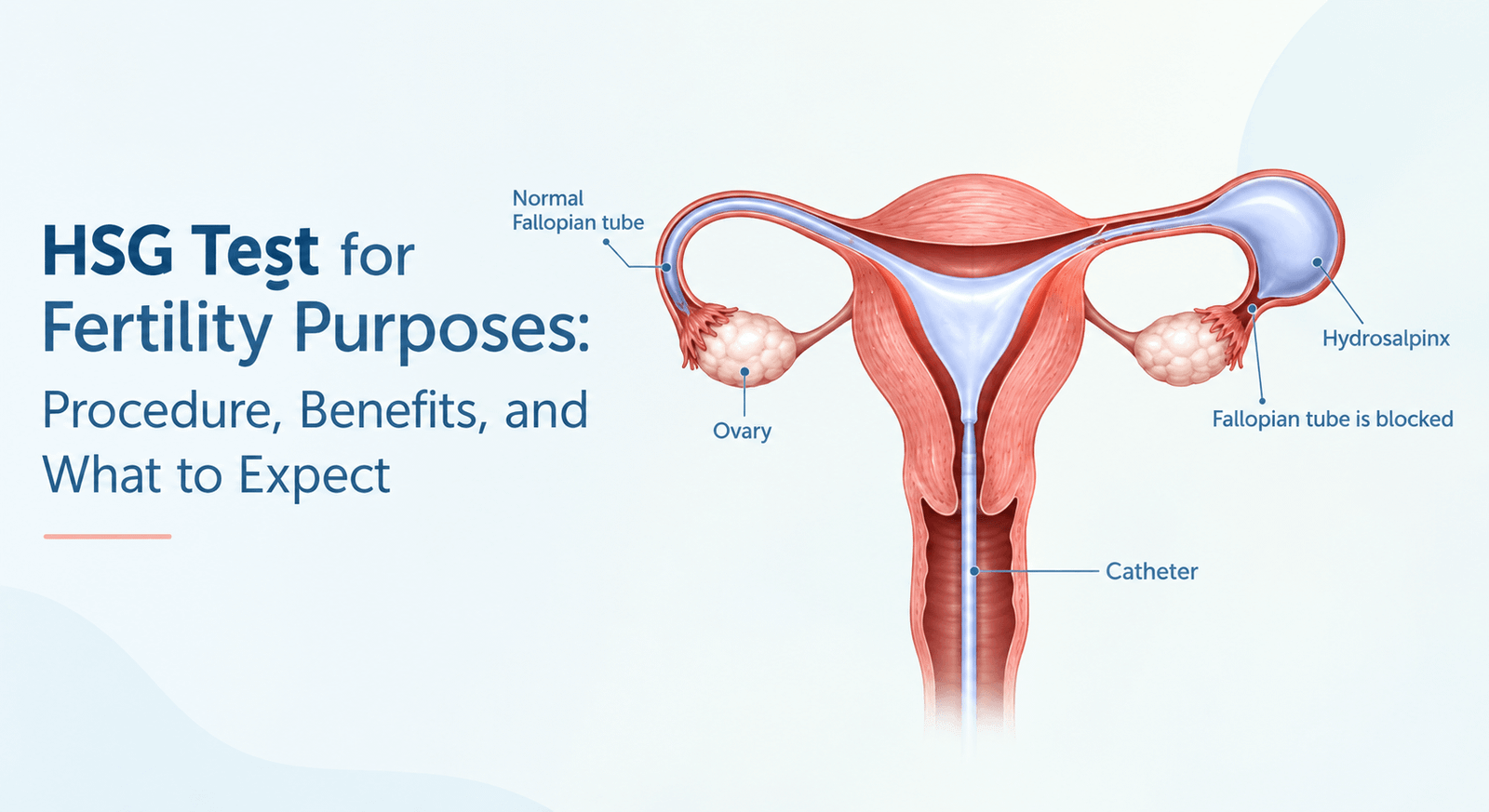
An HSG test, or hysterosalpingogram test, is an X-ray-based diagnostic procedure that evaluates the shape of the uterine cavity and checks whether the fallopian tubes are open.
During the test, a contrast dye is introduced through the cervix into the uterus. X-ray imaging then allows the doctor to observe how the dye moves through the uterus and fallopian tubes.
If the dye passes through the tubes and spills beyond their ends, the tubes are generally considered patent, or open. If the dye stops or does not pass normally through a tube, further evaluation may be needed to determine whether there is a blockage.
HSG is particularly useful when a doctor is investigating possible tubal-factor infertility. However, an HSG is not a complete fertility test by itself. Fertility depends on several factors, including ovulation, ovarian function, sperm health, the uterus, and the fallopian tubes.
Fallopian tubes play an important role in natural conception. After ovulation, the egg needs to enter a fallopian tube, where fertilisation can occur if sperm reaches it. The resulting embryo then travels toward the uterus.
If one or both tubes are blocked, this process can become difficult or impossible depending on the location and extent of the blockage.
An HSG test for infertility may therefore be recommended when:
HSG can identify proximal or distal tubal occlusion and may provide information about the structure of the tubes.
One of the main reasons doctors recommend an HSG is to investigate blocked fallopian tubes.
The test can help determine whether:
However, an HSG result showing blockage does not always mean that a permanent blockage exists. In particular, apparent blockage near the uterus can sometimes be related to temporary tubal or uterine contractions, catheter position, or other technical factors. ASRM notes that suspected proximal blockage may require additional assessment in some cases.
Your fertility specialist will interpret the result together with your medical history, ultrasound findings, and other fertility investigations.
Understanding the procedure beforehand can make the experience feel much less stressful.
You will usually be asked to lie on an examination table in a position similar to that used for a pelvic examination.
The doctor will review your medical history, allergies, medications, and the reason for the test.
A speculum is gently inserted into the vagina so that the cervix can be visualised. The area is cleaned before the next step.
A small catheter is carefully passed through the cervix into the uterus.
A contrast material is slowly introduced through the catheter. The dye fills the uterine cavity and then moves toward the fallopian tubes.
As the dye moves through the reproductive tract, X-ray images are taken. The doctor observes the shape of the uterine cavity and whether the contrast passes through the fallopian tubes.
Once the required images have been obtained, the catheter is removed. The entire process is generally performed without hospital admission.
The exact technique may vary depending on the medical facility, the patient’s anatomy, and the doctor’s assessment.
Proper HSG test preparation helps make the procedure safer and more comfortable.
Your doctor may recommend:
HSG should generally not be performed when pregnancy is possible, during active pelvic infection, or in certain other circumstances. Your doctor will determine whether the test is appropriate for you.
Do not take medication before the test unless your doctor has advised you to do so.
One of the most common questions patients have is, “Will an HSG test hurt?”
The experience varies from person to person. Some women experience mild to moderate cramping when the catheter is inserted or when the contrast passes through the uterus and tubes. Others experience only mild discomfort.
You may also notice:
The procedure is usually brief, but individual experiences can differ.
It is helpful to communicate with your healthcare team if you experience significant discomfort during the test. They can guide you through the process and discuss appropriate pain-management options.
The main HSG test benefits come from the information it provides.
HSG can show whether the fallopian tubes appear open or whether there is evidence of blockage.
When tubal problems are suspected, HSG can provide important information that helps guide the next stage of fertility evaluation.
The test can also provide information about the shape and contour of the uterine cavity.
The results may help your fertility specialist decide whether further evaluation, surgery, IUI, IVF, or another approach should be considered.
Unlike diagnostic laparoscopy, HSG does not require abdominal incisions. It is an imaging-based assessment of the reproductive tract.
It is important to remember that HSG is a diagnostic test, not a guarantee of pregnancy. In some circumstances, tubal flushing associated with HSG may have a temporary fertility-enhancing effect, but this should not be considered the primary purpose of the test.
After the procedure, most patients can return to their normal activities according to their doctor’s advice.
Some mild cramping or spotting may occur temporarily. Your doctor will explain when to seek medical attention and what symptoms should not be ignored.
If the HSG suggests that the tubes are open, your fertility specialist can consider the result along with other factors such as ovulation, ovarian reserve, uterine health, and semen analysis.
If a blockage is suspected, additional testing may sometimes be required before making a treatment decision. This is particularly important when the HSG suggests blockage close to the uterus, because some apparent blockages can be false positives.
An HSG is only one component of a complete fertility assessment.
Depending on your individual situation, your doctor may also recommend:
A complete evaluation helps identify whether the difficulty conceiving is related to the fallopian tubes, ovulation, sperm factors, the uterus, or a combination of factors. ASRM recommends evaluating both partners when appropriate rather than focusing only on female fertility.
Choosing a fertility centre involves more than looking for a single diagnostic test. Look for a facility where diagnosis, fertility counselling, imaging, minimally invasive procedures, and assisted reproductive treatments can be coordinated when needed.
For patients searching for Fertility Hospital Facilities in Vadodara, having diagnostic and treatment services available within the same fertility centre can make the journey more convenient.
Safal IVF & Laparoscopy Centre provides fertility evaluation and diagnostic services, including HSG for tubal blockage, ultrasound and sonography, hormonal testing, semen analysis, and hysteroscopy and laparoscopy. The centre also provides IVF, IUI, ICSI, fertility preservation, and other assisted reproductive services.