When Hope Needs a New Path
For many couples, the dream of holding their own baby feels natural and straightforward until fertility challenges make the journey more complicated than expected. While modern fertility treatments have helped millions achieve parenthood, some situations require a different approach. One such advanced fertility solution is IVF with donor eggs.
For women facing poor egg quality, diminished ovarian reserve, premature menopause, or repeated IVF failures, donor egg IVF can offer a renewed opportunity to experience pregnancy and childbirth. Although the medical process is highly successful, the emotional journey can often feel overwhelming and raise many questions.
Understanding how the treatment works, who can benefit from it, and what emotional experiences to expect can help intended parents move forward with confidence and hope.
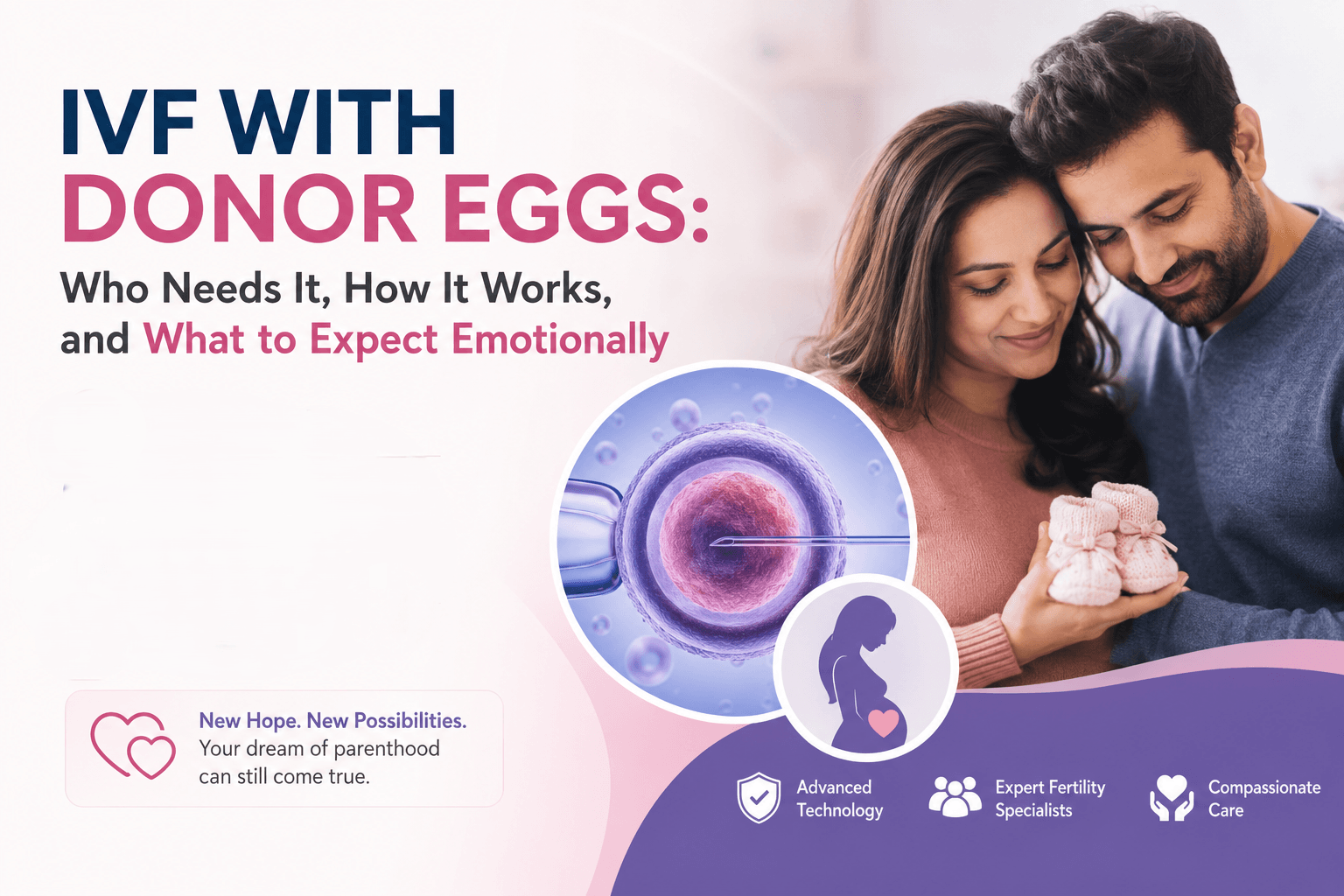
IVF with donor eggs is an assisted reproductive treatment in which eggs from a healthy donor are used to create embryos through in vitro fertilization. The donor eggs are fertilized with sperm from the intended father or a donor sperm source, and the resulting embryo is transferred into the recipient mother’s uterus.
Since the embryo develops inside the recipient mother’s womb, she experiences pregnancy, childbirth, and the bond of carrying her baby, even though the egg originated from a donor.
This treatment has become one of the most successful fertility options available today for women who cannot conceive using their own eggs.
Many people wonder, who needs donor eggs for IVF? While every fertility case is unique, doctors may recommend donor egg fertility treatment in the following situations:
As women age, both egg quantity and quality naturally decline. Women above 40 often experience reduced fertility due to chromosomal abnormalities in eggs, making conception difficult.
Some women experience menopause much earlier than expected, leading to a significant reduction in healthy eggs.
Even younger women can have a low ovarian reserve, meaning their ovaries contain fewer viable eggs than normal.
Repeated unsuccessful IVF treatments may indicate underlying egg quality issues that donor eggs can help overcome.
Women carrying hereditary genetic conditions may choose IVF using donor eggs to reduce the risk of passing those conditions to their child.
Chemotherapy, radiation, or certain surgeries can affect ovarian function and egg quality, making donor eggs a suitable alternative.
Understanding the process helps reduce anxiety and creates realistic expectations.
The fertility specialist evaluates both partners through medical history reviews, hormone testing, ultrasound scans, and semen analysis.
The donor undergoes extensive medical, genetic, and psychological screening. Fertility clinics ensure that donors meet strict health and quality standards.
The donor receives hormonal medications to stimulate egg production. Mature eggs are then collected through a minor procedure.
The retrieved eggs are fertilized using sperm from the intended father or donor sperm in the laboratory.
The embryos are carefully monitored for several days to assess their growth and quality.
The healthiest embryo is transferred into the recipient mother’s uterus, where implantation and pregnancy can occur.
Approximately two weeks after embryo transfer, a pregnancy test confirms the treatment outcome.
One of the biggest advantages of egg donor IVF is its impressive success rate.
Because donor eggs typically come from young, healthy women with proven fertility potential, the quality of embryos created is often significantly higher than embryos produced using aging or compromised eggs.
Studies worldwide consistently show that donor egg IVF success rates are among the highest in assisted reproductive technology.
Success rates vary depending on factors such as:
Choosing an experienced fertility center can significantly improve treatment outcomes.
While the medical process is straightforward, the emotional journey deserves equal attention.
Many women initially struggle with the idea that the child will not share their genetic material. These feelings are completely natural and often part of the adjustment process.
Over time, many parents discover that parenthood is built through love, care, pregnancy, and lifelong connection rather than genetics alone.
Some individuals experience a sense of loss regarding their original expectations of biological parenthood. Acknowledging these emotions can help create emotional healing.
Concerns about disclosure and how family members may react are common. Professional counseling can provide valuable guidance during this stage.
As treatment progresses and pregnancy develops, most intended mothers experience increasing confidence and excitement about becoming parents.
Research and real-life experiences consistently show that carrying the pregnancy creates a powerful emotional connection between mother and baby long before birth.
Emotional counseling plays a vital role during egg donation treatment.
Fertility counselors help patients:
Seeking emotional support is not a sign of weakness. It is an important step toward making informed and comfortable decisions.
The success of donor egg fertility treatment depends not only on medical expertise but also on the quality of care provided throughout the journey.
When selecting a fertility center, consider:
If you are exploring IVF with donor eggs, choosing the right fertility partner can make all the difference.
Recognized by many patients as one of the Best Fertility Hospitals in Vadodara, Safal Infertility & Laparoscopy Hospital offers advanced fertility solutions supported by modern technology, experienced specialists, and compassionate care.
From detailed fertility evaluations and donor programs to advanced IVF procedures and emotional counseling, the hospital provides comprehensive Fertility Hospital Facilities in Vadodara designed to support every step of your parenthood journey.
Whether you are looking for the Best IVF Center in Vadodara, seeking guidance from a Best Fertility Doctor, or exploring options for donor egg treatment, the dedicated team at Safal Infertility & Laparoscopy Hospital is committed to helping you move closer to your dream of becoming a parent.
Parenthood is not defined by a single path. For many families, IVF with donor eggs becomes the bridge between years of uncertainty and the joy of welcoming a child.
With advances in reproductive medicine, excellent donor egg IVF success rates, and compassionate support from fertility specialists, countless couples are finding hope where they once saw obstacles.
If fertility challenges have made your journey difficult, donor egg IVF may be the opportunity that helps turn your dream of parenthood into reality.