
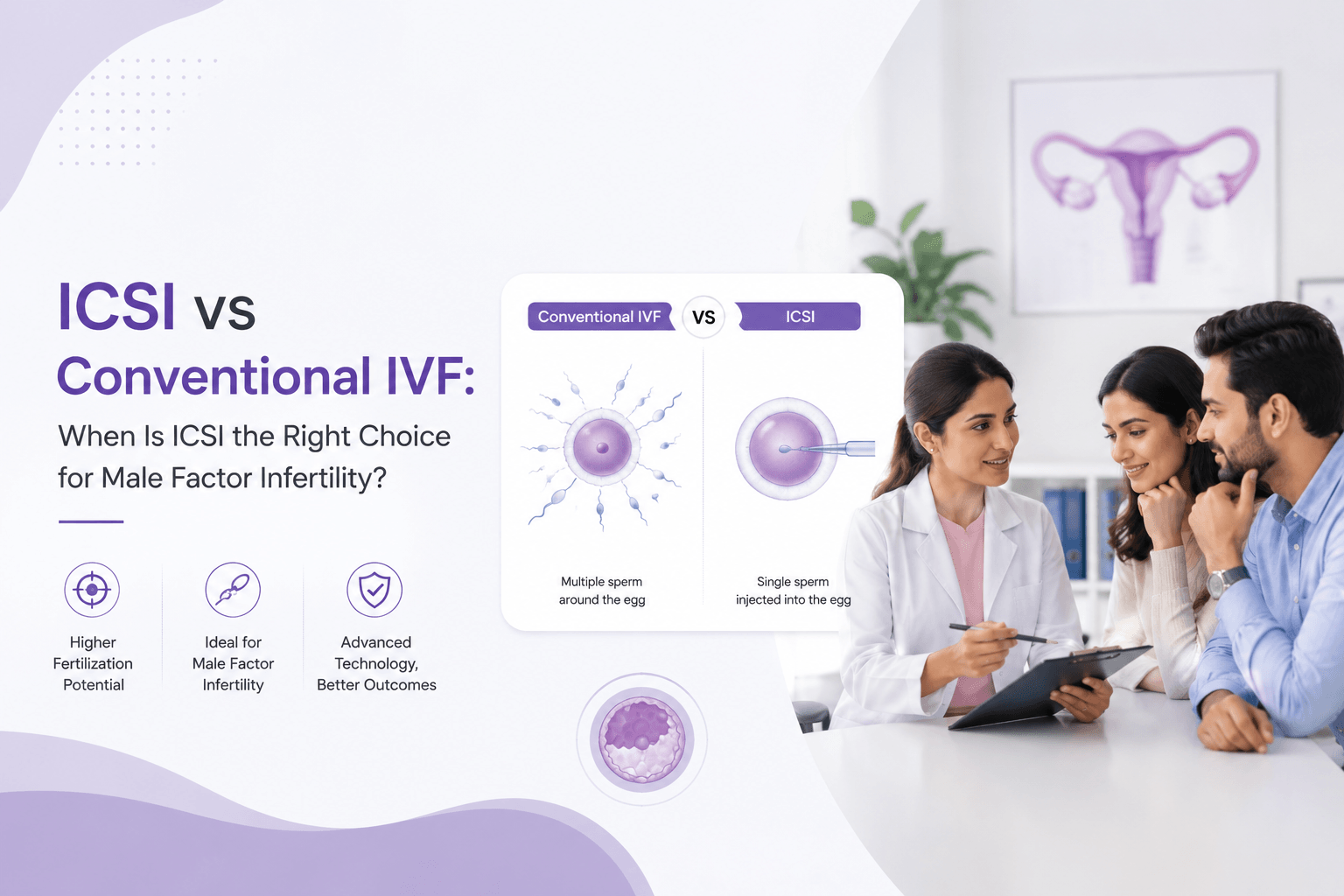
For many couples, the journey to parenthood is not always as simple as expected. When months or even years of trying fail to result in pregnancy, fertility testing often reveals an underlying cause. Surprisingly, male factor infertility contributes to nearly half of all infertility cases, making it one of the most common challenges faced by couples today.
Struggling to Conceive?
The Answer May Lie in Choosing the Right Fertility Treatment
Fortunately, advancements in reproductive medicine have transformed fertility care, offering highly effective solutions through assisted reproductive technologies. Among the most widely recommended treatments are Conventional IVF and ICSI treatment. While both procedures aim to achieve successful fertilization and pregnancy, understanding the difference between ICSI and IVF is crucial when deciding the most appropriate treatment.
If you have been researching ICSI vs IVF, this guide will help you understand how each procedure works, when ICSI is recommended, and which option may offer the best chance of success for couples dealing with male factor infertility.
Conventional IVF (In Vitro Fertilization) is one of the most established fertility treatments available today.
During the IVF process:
Conventional IVF relies on the sperm’s natural ability to fertilize the egg. Therefore, it works best when sperm count, movement, and shape are relatively normal.
Intracytoplasmic Sperm Injection (ICSI) is an advanced fertility technique that was specifically developed to overcome severe male fertility problems.
In ICSI treatment:
Because only one sperm is required per egg, ICSI can successfully overcome many sperm-related challenges that would otherwise reduce the chances of fertilization.
Today, ICSI for male infertility has become one of the most successful fertility treatments worldwide.
Many couples assume that IVF and ICSI are the same procedure. While both treatments share similar initial steps, the fertilization process differs significantly.
Feature | Conventional IVF | ICSI |
Fertilization Method | Sperm fertilizes the egg naturally | Sperm is injected directly into the egg |
Sperm Requirements | Good sperm count and motility are needed | Can work with a very low sperm count |
Male Factor Infertility | Limited effectiveness in severe cases | Highly effective |
Laboratory Technique | Less invasive fertilization | Advanced microscopic procedure |
Fertilization Control | Natural selection process | Direct fertilization assistance |
The primary difference between ICSI and IVF lies in how fertilization occurs. IVF allows sperm and egg to meet naturally, while ICSI actively assists fertilization by injecting a sperm directly into the egg.
Not every fertility patient requires ICSI. However, fertility specialists often recommend ICSI treatment when significant sperm-related issues are identified.
When the sperm count is extremely low, the chances of sperm reaching and fertilizing the egg naturally decrease significantly.
ICSI allows specialists to select the healthiest sperm and directly fertilize the egg, increasing the likelihood of successful fertilization.
Sperm motility refers to the ability of sperm to swim effectively.
If sperm movement is poor, they may struggle to reach or penetrate the egg. ICSI bypasses this challenge completely.
Some men produce sperm with abnormal shape or structure, affecting fertilization ability.
ICSI helps fertility specialists choose the most suitable sperm for injection, improving fertilization outcomes.
Couples who have experienced failed fertilization during a previous Conventional IVF cycle may benefit significantly from ICSI treatment.
In some situations, sperm must be surgically retrieved from the testes or epididymis. Since only a small number of sperm may be available, ICSI becomes the preferred fertilization technique.
Even when routine tests appear normal, hidden sperm function problems can affect fertilization. Fertility specialists may recommend ICSI to maximize the chances of success.
One of the most common questions couples ask is about IVF vs ICSI success rates.
The answer depends largely on the underlying fertility diagnosis.
For couples without male infertility issues, Conventional IVF and ICSI often achieve comparable pregnancy outcomes.
However, when male factor infertility is present, ICSI generally offers:
It is important to note that neither procedure guarantees pregnancy. Success rates also depend on factors such as:
A fertility specialist can recommend the most suitable approach based on individual circumstances.
Choosing between available IVF treatment options requires a thorough fertility evaluation.
Doctors typically assess:
At a trusted fertility center, treatment plans are customized rather than applying the same solution to every patient.
Many couples delay seeking professional help, assuming conception will happen naturally over time.
However, fertility specialists recommend evaluation if:
Early diagnosis allows timely intervention and access to the most effective treatment options.
Choosing the right fertility treatment can make all the difference in your journey toward parenthood. Whether you require Conventional IVF, advanced ICSI treatment, or personalized fertility care, expert guidance is essential.
At Safal Infertility & Laparoscopy Hospital, recognized as a Best Fertility Hospital in Vadodara, couples receive comprehensive fertility evaluation, advanced reproductive technologies, and compassionate support throughout every stage of treatment.
With modern Fertility Hospital Facilities in Vadodara, experienced fertility specialists, and a patient-centered approach, Safal has become a trusted destination for couples seeking fertility solutions. If you are searching for the Best IVF Center in Vadodara, the Best Fertility Hospital, or consultation with the Best Fertility Doctor, our team is committed to helping you achieve your dream of parenthood.
Schedule your fertility consultation today and take the first step toward building the family you’ve always hoped for.
Understanding ICSI vs IVF is essential for couples facing fertility challenges, especially when male factor infertility is involved. While Conventional IVF remains an effective treatment for many patients, ICSI for male infertility has revolutionized fertility care by overcoming sperm-related obstacles and improving fertilization outcomes.
A proper fertility assessment can determine which treatment is right for you. With expert guidance, advanced technology, and personalized care, the path to parenthood may be closer than you think.