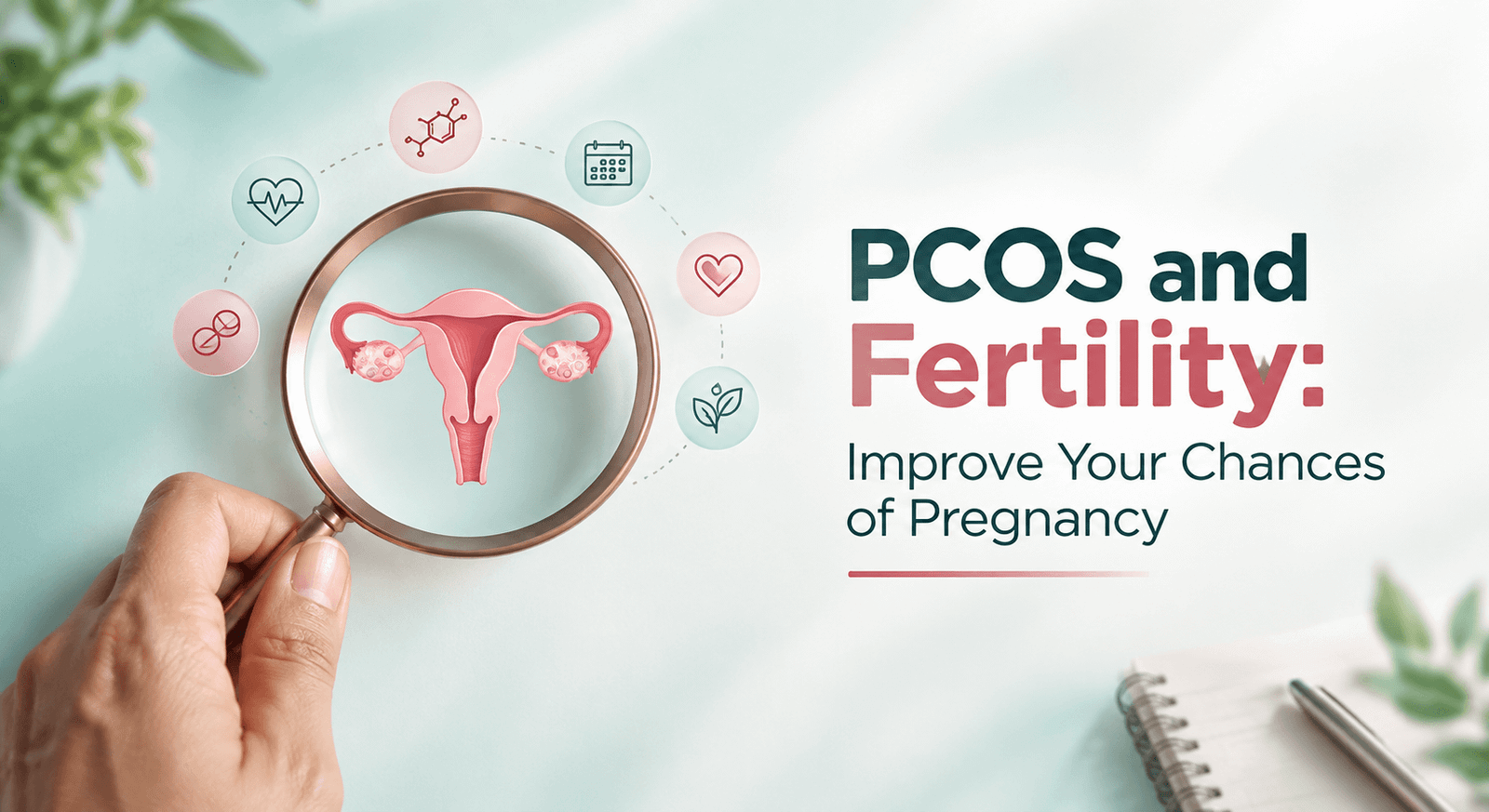
For many women, seeing two lines on a pregnancy test is a deeply hoped-for moment. But when you have PCOS, trying to conceive can sometimes feel unpredictable. Irregular periods, hormonal changes, and problems with ovulation can make it harder to know when you are fertile.
The good news is that PCOS does not mean you cannot become pregnant. Many women with PCOS conceive naturally, while others may need medication or fertility treatment to support ovulation. The key is understanding how PCOS affects fertility and getting the right support at the right time.
If you are wondering about getting pregnant with PCOS, there are several practical steps that can help you prepare your body, identify ovulation, and choose appropriate treatment when needed.
Polycystic ovary syndrome, commonly called PCOS, is a hormonal condition that can affect menstrual cycles, ovulation, metabolism, and reproductive health.
One of the main reasons PCOS can affect fertility is irregular or absent ovulation. When ovulation does not happen regularly, there are fewer predictable opportunities for an egg to meet sperm.
This is why PCOS and ovulation are closely connected when discussing fertility.
However, PCOS affects every woman differently. Some women continue to ovulate and can conceive without fertility treatment, while others experience significant ovulation problems in PCOS and require medical assistance.
The important point is that PCOS-related fertility problems can often be assessed and managed with an individualized treatment plan.
Knowing whether and when you ovulate can be an important first step.
With regular menstrual cycles, predicting ovulation may be relatively straightforward. However, irregular periods can make conventional calendar-based methods less reliable.
Your fertility specialist may recommend methods such as:
If you have very irregular periods, do not assume that you are not ovulating at all. Instead, discuss your cycle pattern with a fertility specialist.
Understanding your individual PCOS and ovulation pattern can help determine whether timed intercourse, ovulation induction, IUI, or another treatment approach may be appropriate.
Lifestyle management is an important part of PCOS care. Current international guidelines recommend healthy eating and regular physical activity for women with PCOS because they can improve overall health, metabolic health, and weight management. Importantly, there is no single diet that has been proven to be the best diet for every woman with PCOS.
Instead of following extreme diets, focus on sustainable habits.
A balanced routine can include:
The goal should not be to chase a particular number on the weighing scale. A healthy lifestyle can provide benefits even without weight loss, and care should be personalized rather than based on weight alone.
For some women with PCOS, managing excess weight may improve metabolic health and reproductive outcomes. The 2023 international guideline recommends discussing weight, nutrition, exercise, sleep, and other preconception factors as part of pregnancy planning.
However, fertility care should never be reduced to weight alone.
If you have a higher body weight, a fertility specialist can help you understand how it may affect ovulation, pregnancy, and fertility treatment. The approach should be realistic, supportive, and personalized.
Likewise, women who are not overweight can still have PCOS infertility and should receive appropriate fertility evaluation rather than being told that weight is the solution.
Preconception care can be particularly important when you have PCOS.
Before trying to conceive, discuss your overall health with your doctor. Your assessment may include blood pressure, nutritional status, medications, metabolic health, menstrual history, and other factors that could affect pregnancy.
Folate supplementation is also part of routine preconception care. The PCOS guideline recommends considering folate supplementation and other preconception factors before pregnancy.
Do not start, stop, or change prescription medicines on your own. Some medications used to manage PCOS are not intended for use during pregnancy, so your treatment plan should be reviewed when you begin trying to conceive.
PCOS may be contributing to difficulty conceiving, but it is not necessarily the only factor.
Fertility involves both partners. Depending on your situation, your doctor may evaluate:
This is important because treating ovulation alone may not address another underlying fertility issue.
For example, if blocked fallopian tubes or male-factor infertility are also present, your treatment plan may need to be different.
A complete fertility evaluation can therefore provide a clearer path toward conception.
If irregular or absent ovulation is making conception difficult, your fertility specialist may recommend ovulation-induction treatment.
According to the international PCOS guideline, letrozole is recommended as the first-line pharmacological treatment for ovulation induction in women with PCOS-related anovulatory infertility when there are no other infertility factors.
Other treatments may be considered depending on your individual circumstances, previous treatment, medical history, and local clinical practice.
For example, clomiphene, metformin, gonadotrophins, or other approaches may have a role in selected patients. These medicines require medical supervision and should not be taken without a fertility specialist’s guidance.
This is why searching online for how to conceive with PCOS should not replace an individualized medical assessment.
Not every woman with PCOS needs IVF.
Many women can conceive naturally or with relatively simple ovulation treatment. However, if other treatments do not work, or if another fertility factor is present, assisted reproductive techniques may be considered.
Depending on the situation, treatment can include:
Ovulation induction: Medication is used to encourage ovulation, often with monitoring.
IUI: Prepared sperm is placed directly into the uterus around the time of ovulation.
IVF: Eggs are collected, fertilized in a laboratory, and resulting embryos are transferred to the uterus.
The international guideline states that IVF can be considered in women with PCOS and anovulatory infertility when other ovulation-induction approaches have failed and there is no separate indication requiring IVF. It also highlights the importance of strategies that reduce the risk of ovarian hyperstimulation syndrome in women with PCOS undergoing IVF.
Therefore, PCOS fertility treatment should be selected according to your age, ovarian function, ovulation pattern, duration of infertility, partner’s fertility factors, previous treatments, and other clinical findings.
You do not always have to wait a full year if you already know that you have a condition affecting ovulation.
If your periods are very irregular or absent, you have been diagnosed with PCOS and are struggling to conceive, or you have other known fertility concerns, speak with a fertility specialist earlier.
Age also matters. For women over 35, fertility evaluation is generally recommended sooner after unsuccessful attempts to conceive.
Early evaluation does not automatically mean IVF. It simply helps identify the reason for delayed conception and gives you more options.
Getting pregnant is only one part of the journey. PCOS is also associated with an increased risk of certain pregnancy complications, so appropriate prenatal care is important.
The international guideline recommends optimizing health and preconception factors before pregnancy and monitoring women with PCOS during pregnancy.
Once you receive a positive pregnancy test, inform your doctor promptly. Your healthcare team can review your medications, monitor your pregnancy, and provide appropriate prenatal care.
No. A PCOS diagnosis does not automatically mean infertility.
The main issue is often irregular ovulation, which can reduce the number of opportunities for conception. However, many women with PCOS achieve pregnancy naturally, while others may need medication or assisted reproductive treatment.
The right approach is to understand what is actually causing difficulty conceiving rather than assuming that PCOS is the only reason.
If you are searching for ways to improve fertility with PCOS, start with the basics: understand your ovulation, maintain sustainable healthy habits, prepare for pregnancy, evaluate both partners when appropriate, and seek professional help when needed.
Most importantly, avoid comparing your fertility journey with someone else’s. PCOS can look very different from one woman to another, so treatment should be based on your individual reproductive health.
With proper evaluation and personalized care, PCOS and fertility can be managed with a range of evidence-based options. The journey may require patience, but a PCOS diagnosis does not mean that parenthood is out of reach.
With Safal Infertility & Laparoscopy Hospital, fertility care is designed around individual patient needs. The centre provides fertility evaluation and treatments including IVF, IUI, ICSI, infertility counselling, fertility testing, and laparoscopic and hysteroscopic procedures. Its published services also include evaluation of female and male infertility and personalized fertility treatment planning.
If you are looking for the Best Fertility Hospital in Vadodara, Best Fertility Hospital, or Best IVF Centre in Vadodara, speak with a qualified fertility specialist to understand your options. The right evaluation can help determine whether lifestyle management, ovulation induction, IUI, IVF, or another approach is appropriate for you.